
YINGBA · CARBIDE CNC CUTTING TOOLS
Engraving Bits for Metal & Wood
Fine-tip engraving geometries for metal and wood lettering.
Tip angle 20°–45° · tip Ø from 0.1 mm · 3.175 to 6 mm shanks
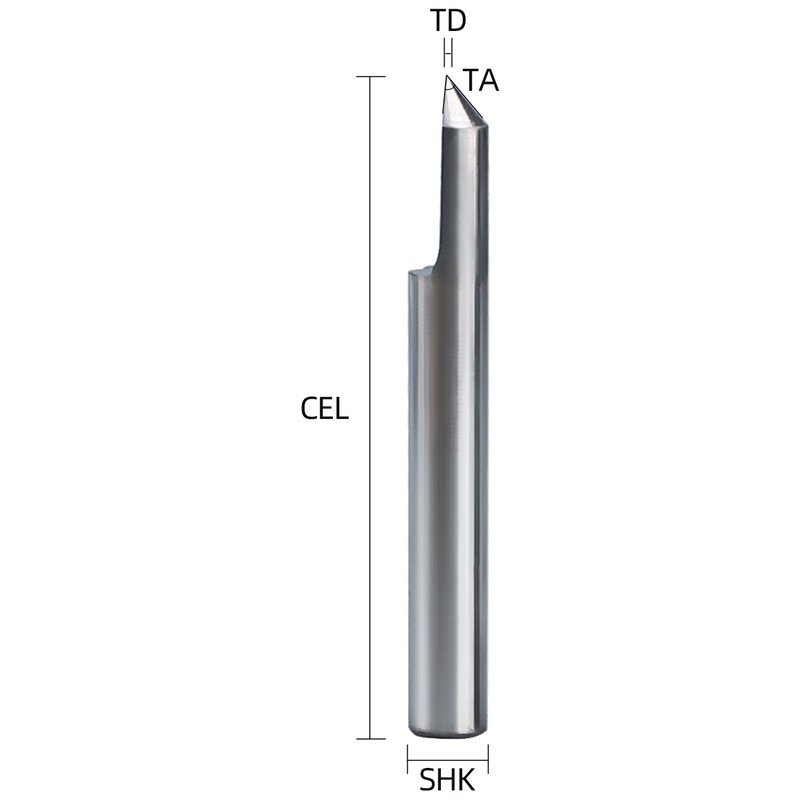
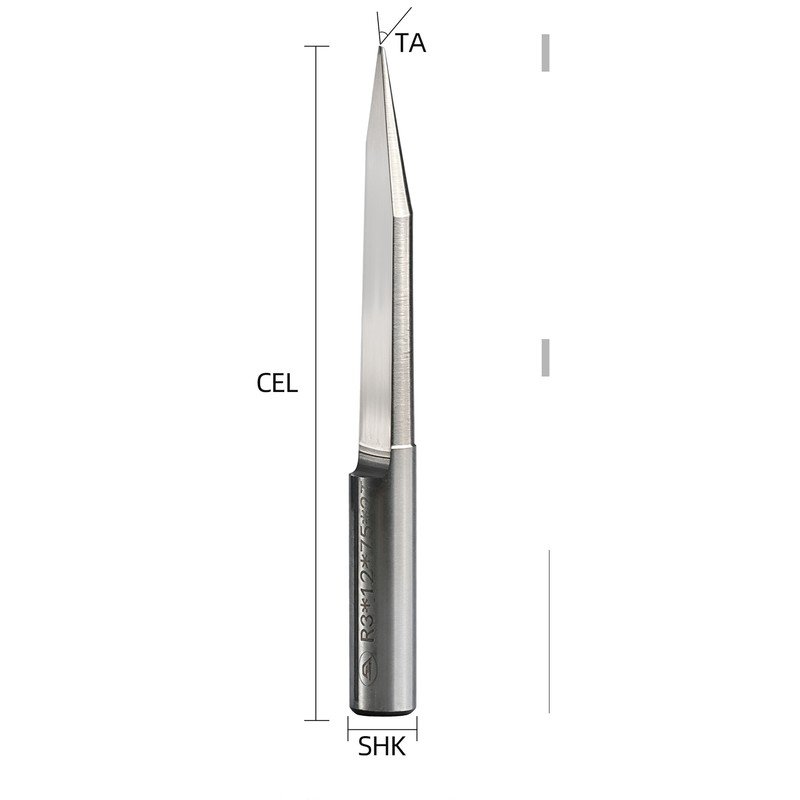
Quick answer: engraving bits are taper tools with a very small flat at the tip, so they cut a fine, consistent line and leave a flat bottom instead of a sharp V. Two versions are offered: one for metal, with tip angles from 20° to 45° and tip diameters from 0.1 mm, and one for wood with a 30° tip. They are used for lettering, marking and fine detail where line width must stay consistent.
Materials and machines
- Materials: Metal version: aluminium alloy, brass, copper, thin iron sheet, cold-rolled steel sheet, bakelite, resin board, synthetic tooling board. Wood version: MDF, particle board, plywood, solid wood board, glued timber, melamine-faced board, pine, oak, rosewood, walnut, bamboo board and bamboo strip
- Machines: Advertising CNC engraving machines, CNC engraving-milling machines, compact vertical CNC machining centres, CNC nesting routers, small stone CNC engraving machines
Feed rate, spindle speed and depth of cut must be matched to the tool diameter, material, machine rigidity and workholding. These are application-specific and are confirmed for each order.
Complete size list
The metal and wood versions differ in tip geometry and in the materials they are specified for. Confirm the version you need when ordering.
Engraving bit for metal
A finer tip angle and smaller tip diameter for metal lettering and marking.
| Shank (mm) | Tip angle | Tip Ø (mm) | Overall length (mm) |
|---|---|---|---|
| 3.175 | 20° – 45° | 0.1 – 0.3 | 33 |
| 4 | 30° – 45° | 0.2 – 0.5 | 45 |
| 6 | 30° – 45° | 0.2 – 0.5 | 50 |
Woodworking flat bottom taper bit
A 30° tip ground for wood-based boards and solid timber.
| Shank (mm) | Tip angle | Overall length (mm) |
|---|---|---|
| 3.175 | 30° | 29 |
| 4 | 30° | 45 |
| 6 | 30° | 45 – 60 |
Frequently asked questions
What are engraving bits used for?
Lettering, marking and fine detail work. The tip is tapered with a very small flat, so it cuts a consistent line at a controlled width.
What is the difference between the metal and wood versions?
The metal version uses finer tip angles from 20° to 45° with tip diameters from 0.1 mm. The wood version is a 30° tip ground for wood-based boards and solid timber.
How does a flat bottom taper bit differ from a V-bit?
A V-bit comes to a point, so the groove depth sets the stroke width. A flat bottom taper bit has a small flat at the tip, which gives a more consistent line width and a flat groove floor.
Which materials are listed?
The metal version is listed for aluminium alloy, brass, copper, thin iron sheet, cold-rolled steel sheet, bakelite, resin board and synthetic tooling board. The wood version is listed for MDF, particle board, plywood, solid wood, glued timber, melamine-faced board, pine, oak, rosewood, walnut and bamboo.
Can I order a specific tip angle and tip diameter?
Yes. Tip angle, tip diameter, cutting length and overall length can be produced to your drawing.
Related guides and tools
Need a matched tool recommendation?
Tell us the material, the operation and your machine. YINGBA will review the requirement and prepare a B2B quotation.