
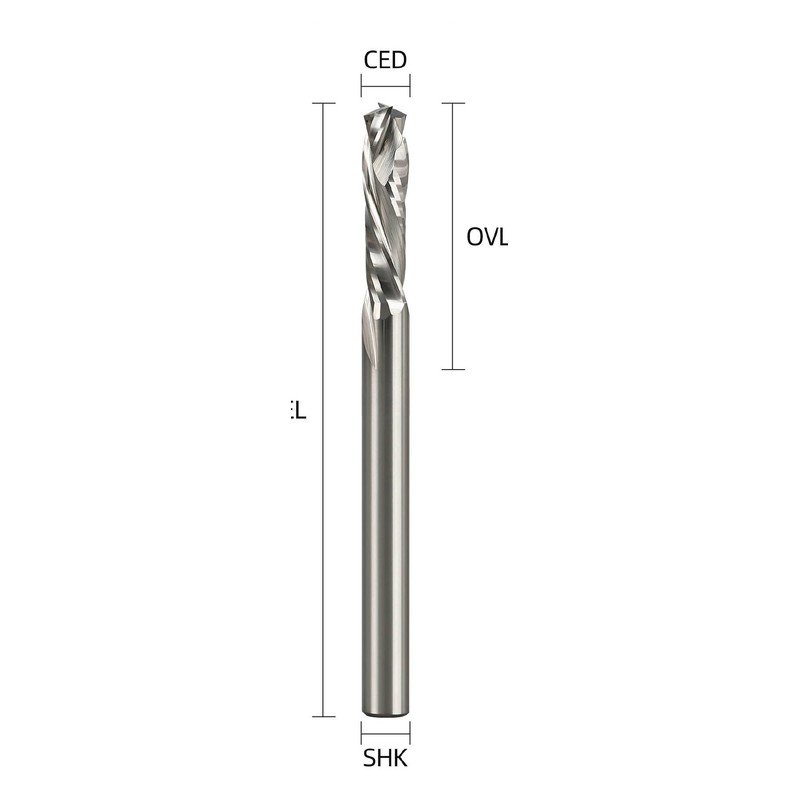
Up-Cut vs Down-Cut vs Compression Router Bits: How to Choose
Choosing the wrong spiral direction is one of the most common causes of poor edge finish in CNC woodworking. This guide explains the three main spiral geometries and when to use each.
Quick answer: an up-cut bit clears chips upward and leaves the bottom edge clean; a down-cut bit presses the top face down and leaves the top edge clean; a compression bit combines both — up-cut at the tip, down-cut above — and gives clean edges on both faces, provided you cut through the full panel thickness.
Up-Cut Router Bits
Up-cut bits pull chips upward — away from the cutting tip toward the shank. This is the most common spiral direction.
Advantages
- Excellent chip evacuation — ideal for deep cuts and slot cutting
- Cooler cutting — chips carry heat away from the cutting zone
- Good for blind holes and internal pockets
Limitations
- Tends to fray or tear the top surface of the workpiece
- Can lift thin or unclamped materials
Best for
- Through-cuts where the top surface quality is less critical
- Deep slotting and roughing operations
- Materials where chip packing is a concern (MDF, plywood)
Down-Cut Router Bits
Down-cut bits push chips downward — toward the workpiece. This compresses the top surface fibers during cutting.
Advantages
- Clean, tear-free finish on the top surface
- Holds thin or delicate materials down during cutting
- Ideal for veneered or laminated panels
Limitations
- Poor chip evacuation — chips are pushed into the cut
- Not suitable for deep cuts due to heat buildup
- Can fray the bottom surface of through-cuts
Best for
- Shallow cuts where top surface finish is critical
- Laminated MDF, melamine, and veneered plywood
- Engraving thin materials without lifting
Compression Router Bits
Compression bits combine up-cut and down-cut geometry in one tool — the tip carries the up-cut section while the upper flutes are down-cut. As the bit exits the bottom of the panel, the up-cut tip presses the material against the panel and keeps the bottom face clean, while the down-cut section above pushes the top surface fibres downward and protects the top edge. This presses the fibres on both faces toward the centre of the panel.
Advantages
- Clean edges on both top and bottom surfaces
- Ideal for cutting double-sided laminated panels
- Reduces delamination in plywood and coated boards
Limitations
- Requires full-depth cut to engage both sections — not for shallow profiling
- Typically more expensive than single-direction bits
- Less forgiving of incorrect feed rates
Best for
- Cabinet and furniture parts with laminated surfaces
- Through-cuts in double-sided melamine or veneer panels
- Any application where both top and bottom edge quality matters
| Up-cut | Down-cut | Compression | |
|---|---|---|---|
| Chip flow | Up and out of the cut | Down into the cut | Split: up at the tip, down above |
| Top edge | Can fray | Clean | Clean |
| Bottom edge | Clean | Can fray | Clean |
| Axial force | Lifts the workpiece | Presses the workpiece down | Mild lift |
| Best use | Through-cuts, deep slots, roughing | Shallow cuts, veneered and laminated faces | Full-depth through-cuts in double-faced panels |
Practical parameters: in double-faced panels, run a compression bit at roughly 0.08-0.12 mm chip load per tooth and cut the full thickness in one pass so both flute sections engage — a compression bit used for a shallow cut behaves like a poorly-clearing down-cut bit. Down-cut bits work best at shallow depth (half the tool diameter or less) because chips recirculate in the cut; watch the heat and clear them with strong extraction. Up-cut bits tolerate the deepest cuts, so they remain the default for slotting and roughing where the top face will be trimmed or hidden.
Quick Selection Guide
| Application | Recommended Bit |
|---|---|
| Deep slotting, roughing | Up-cut |
| Clean top surface, shallow cut | Down-cut |
| Through-cut, both sides laminated | Compression |
| Solid wood profiling | Up-cut or down-cut (based on edge location) |
| Melamine / veneer panel cutting | Compression |
Important Notes
The feed rate, spindle speed, and depth of cut must be matched to the specific tool diameter, material, and machine rigidity. The values above are general guidance only — always consult the tool supplier for application-specific parameters.
FAQ
What is the difference between an up-cut and a down-cut router bit? An up-cut bit pulls chips upward and leaves the bottom edge clean while the top face may fray; a down-cut bit pushes chips down, presses the top face against the bed and leaves the top edge clean while the bottom may fray. Direction is about which face you must protect.
When should I use a down-cut bit? Use down-cut when the visible face is on top: veneered or laminated panels, thin sheets that tend to lift, and shallow engraving. Keep the depth of cut shallow because down-cut geometry clears chips poorly and heat builds quickly.
Do I need a compression bit for plywood? Only if both faces must stay clean on a through-cut — for example, double-sided veneered or melamine-faced plywood. For a single visible face a down-cut bit is enough, and for non-critical faces an up-cut bit clears chips better.
Need help selecting the right router bit? Contact us with your application details and we will recommend the appropriate tool.
Response
[…] Read our complete comparison of up-cut, down-cut, and compression router bits. […]