YINGBA · CARBIDE CNC CUTTING TOOLS
Two-Flute Ball-Nose Router Bits
A true ball-nose profile for 3D carving, relief machining and smooth contours.
One ball-nose cutter only · Two spiral flutes · Rounded end profile
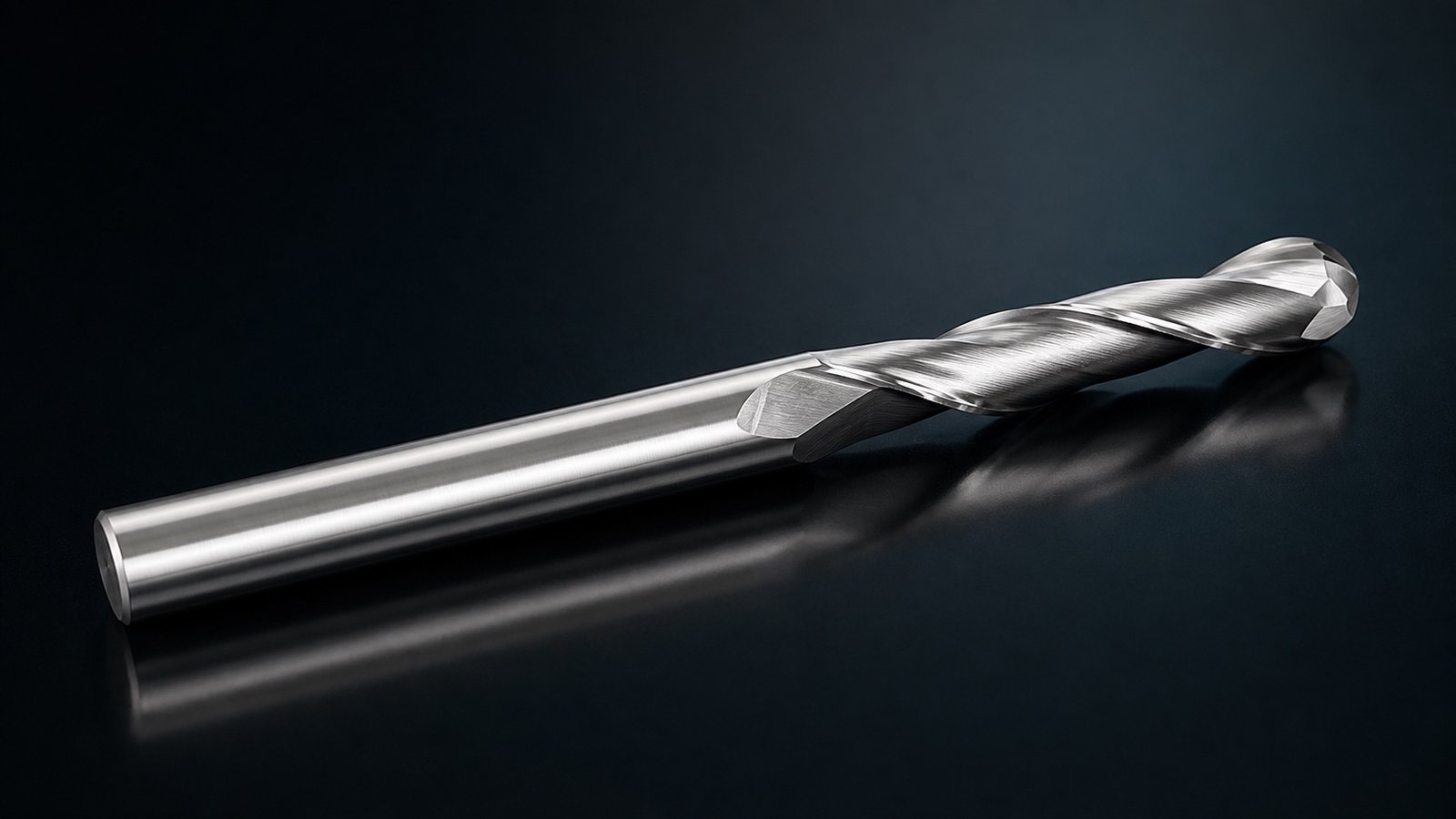
Click the image to inspect the cutting geometry in full size.
Quick answer: a two-flute ball-nose router bit has a rounded, ball-shaped cutting tip and two flutes. The rounded tip follows curved surfaces and produces smooth 3D contours without leaving sharp steps, while the two flutes balance chip clearance and surface finish. It is used for 3D carving, relief work, contour finishing and mould profiles in wood, MDF, plywood, acrylic and plastics. To compare tool shapes first, see ball nose vs flat end mill vs V-bit.
Designed for the job, specified for your machine
YINGBA two flute ball nose router bits are solid carbide tools for 3D carving, relief machining and smooth contour finishing on CNC routers and engraving machines.
The rounded cutting end is suited to three-dimensional profiles and finishing passes where a flat end mill cannot follow the required surface. Select diameter and cutting length around reach, rigidity and surface-finish targets.
QSR SERIES
Complete Size List — Two-Flute Ball Nose
Solid tungsten carbide two-flute ball-nose bits with mirror-edge grinding and large chip gullets. Recommended starting parameters: 18,000–20,000 RPM, feed 3–5 m/min. Suitable for EVA foam, MDF/HDF, plywood, natural hardwood and softwood.
| Code No. | Shank Ø (mm) | Cutting Ø (mm) | Flute (mm) | Overall (mm) |
|---|---|---|---|---|
| qsr3-1.5-6 | 3.175 | 1.5 | 6 | 38 |
| qsr3-2-8 | 3.175 | 2 | 8 | 38 |
| qsr3-2-12 | 3.175 | 2 | 12 | 38 |
| qsr3-2-17 | 3.175 | 2 | 17 | 38 |
| qsr3-2-22 | 3.175 | 2 | 22 | 38 |
| qsr3-2.5-12 | 3.175 | 2.5 | 12 | 38 |
| qsr3-2.5-17 | 3.175 | 2.5 | 17 | 38 |
| qsr3-2.5-22 | 3.175 | 2.5 | 22 | 38 |
| qsr3-12 | 3.175 | 3.175 | 12 | 38 |
| qsr3-17 | 3.175 | 3.175 | 17 | 38 |
| qsr3-22 | 3.175 | 3.175 | 22 | 38 |
| qsr3-32 | 3.175 | 3.175 | 32 | 55 |
| qsr4-12 | 4 | 4 | 12 | 40 |
| qsr4-17 | 4 | 4 | 17 | 40 |
| qsr4-22 | 4 | 4 | 22 | 45 |
| qsr4-25 | 4 | 4 | 25 | 45 |
| qsr4-32 | 4 | 4 | 32 | 60 |
| qsr4-42 | 4 | 4 | 42 | 70 |
| qsr6-17 | 6 | 6 | 17 | 45 |
| qsr6-22 | 6 | 6 | 22 | 45 |
| qsr6-25 | 6 | 6 | 25 | 50 |
| qsr6-32 | 6 | 6 | 32 | 55 |
| qsr6-42 | 6 | 6 | 42 | 70 |
| qsr6-52 | 6 | 6 | 52 | 80 |
| qsr6-65 | 6 | 6 | 65 | 100 |
| qsr8-25 | 8 | 8 | 25 | 50 |
| qsr8-32 | 8 | 8 | 32 | 60 |
| qsr8-42 | 8 | 8 | 42 | 70 |
| qsr8-52 | 8 | 8 | 52 | 80 |
| qsr8-62 | 8 | 8 | 62 | 100 |
| qsr10-32 | 10 | 10 | 32 | 70 |
| qsr10-42 | 10 | 10 | 42 | 75 |
| qsr10-52 | 10 | 10 | 52 | 80 |
| qsr10-62 | 10 | 10 | 62 | 100 |
| qsr10-82 | 10 | 10 | 82 | 120 |
| qsr10-100 | 10 | 10 | 100 | 150 |
All dimensions in millimetres. Recommended flute length: 2–5 mm beyond the material thickness; excessive flute length increases breakage risk.
Recommended materials
- High- and medium-density fiberboard
- Particle board and multilayer board
- Natural hardwood and softwood
- Acrylic, PVC and resin board
Typical specification range
| Shank diameter | 3.175–12 mm |
| Cutting diameter | Approx. 1.5–12 mm |
| Cutting length | Approx. 6–100 mm |
| Overall length | Approx. 38–150 mm |
Exact availability and suitability depend on the selected geometry, workpiece material, machine and cutting conditions. Please confirm the final specification before ordering.
Machines and applications
- Advertising CNC engraving machines
- CNC wood-cutting machines and router moulders
- Desktop and mini CNC engraving machines
- 3D carving, relief work, contour finishing and mould profiles
Share your machine model, spindle speed range, workpiece material and target finish. Our team will help match the tool geometry to the application.
OEM & ODM options
- Custom shank, cutting diameter, cutting length and overall length
- Flute geometry and cutting direction for the intended process
- Coating options where applicable
- Laser marking and export packaging
- Sampling and production quantities reviewed against your specification
What to send for a quote
- Tool drawing or required dimensions
- Material to cut and desired finish
- Machine type, spindle speed and feed conditions
- Required quantity, marking and packaging
Drawings can be sent after your website inquiry by email to sales@yingbatools.com or by WhatsApp.
Catalog size matrix
Two-flute spiral ball end mills for 3D contouring, curved surfaces and finishing. Dimensions are in millimetres.
| Shank Ø | Cutting Ø | Cutting length | Overall length |
|---|---|---|---|
| 3.175 | 1.5–3.175 | 6–32 | 38–55 |
| 4 | 4 | 12–32 | 45–55 |
| 5 | 5 | 25 | 50 |
| 6 | 6 | 17–62 | 45–100 |
| 8 | 8 | 25–80 | 50–120 |
| 10 | 10 | 25–100 | 60–150 |
| 12 | 12 | 32–100 | 65–150 |
Catalog ranges show available size families; exact diameter/length combinations, stock, MOQ and lead time are confirmed in the quotation.
Recommended materials
MDF/HDF, particle board, plywood, hardwood, softwood, acrylic, PVC and resin board.
Typical machines
CNC engraving machines, CNC wood cutting machines, CNC router moulders and desktop/mini CNC machines.
Ball nose vs flat end mill: which shape for your cut?
| Ball nose | Flat end mill | |
|---|---|---|
| Cutting profile | Rounded tip that reproduces curved surfaces | Flat bottom that leaves square internal corners |
| Best for | 3D carving, relief finishing, contour work and mould profiles | Pockets, straight walls and flat-bottom recesses |
| Limitation | Cannot cut a flat bottom or a sharp internal corner | Cannot follow a curved surface smoothly |
Most 3D jobs use both shapes: a flat end mill to remove the bulk of the material, then a ball nose to finish the curved surface. Where the cutter has to reach deep into a shape, a tapered body adds rigidity, as covered in tapered ball nose bits for 3D carving and relief.
Frequently asked questions
What is a ball nose router bit used for?
It is used for 3D carving, relief work, contour finishing and mould profiles, anywhere the surface is curved and the tool has to follow it without leaving steps. It is used in wood, MDF, plywood, acrylic and plastics.
Ball nose vs flat end mill — when should I use each?
A flat end mill gives a flat bottom and square corners, so it is used for pockets, straight walls and flat recesses. A ball nose follows curves and is used for 3D surfaces and relief finishing. On most carved parts the two are used together, with the flat end mill roughing and the ball nose finishing. See the full comparison.
What is the difference between a ball nose and a tapered ball nose bit?
A ball nose has a straight body, while a tapered ball nose narrows toward the tip. The taper adds rigidity and reach for deeper relief work. Use a straight ball nose when reach is not a constraint, and a tapered one when the cutter has to go deep into a shape.
How do I choose the tip radius?
Match the radius to the smallest feature in the model, because a bit cannot reproduce detail finer than its own radius. Smaller radii hold fine detail and are used for finishing, while larger radii cover area faster and leave a broader, smoother surface. Finishing stepover is usually kept to a small fraction of the cutting diameter.
Can a ball nose bit cut acrylic and plastics?
Yes. Ball nose tools are offered for acrylic, PVC and resin board as well as wood-based materials. Because plastics build up heat more easily, feeds and speeds should be reviewed for the specific material. Tell us the material and we will confirm a suitable geometry and coating.
Related guides and tools
Need a matched tool recommendation?
Tell us the material, machine and dimensions. YINGBA will review your requirement and prepare a B2B quotation.