
YINGBA · CARBIDE CNC CUTTING TOOLS
Compression Router Bits
Clean, chip-free edges on both faces of laminated panels in a single full-depth pass.
Up-cut at the tip · Down-cut above · Single and two-flute options
Quick answer: a compression router bit carries two spiral directions on one body — an up-cut section at the tip and a down-cut section above it. The up-cut tip lifts the bottom fibres upward while the down-cut section presses the top fibres downward, so a full-depth through cut leaves clean edges on both faces. It is designed for two-sided laminated panels such as melamine, veneered plywood and laminate.
Designed for the job, specified for your machine
A compression bit exists to solve one specific problem: cutting a two-sided laminated panel without chipping either face. A standard up-cut bit leaves the bottom clean but can tear the top; a down-cut bit protects the top but frays the bottom. A compression bit combines both directions so the top and bottom fibres are pressed toward the centre of the panel and both faces stay clean in a single pass.
Because the geometry depends on both sections engaging, a compression bit is used for full-depth through cuts rather than shallow profiling. Select the diameter and cutting length around the panel thickness and the material being cut. For the surrounding theory, see compression router bits: when and how to use them and up-cut vs down-cut vs compression.
When a compression bit works — and when it doesn’t
| Compression | Up-cut | Down-cut | |
|---|---|---|---|
| Spiral direction | Up-cut at the tip, down-cut above | Up-cut | Down-cut |
| Top edge | Clean | Can fray | Clean |
| Bottom edge | Clean | Clean | Can fray |
| Chip evacuation | Good | Strongest | Poor in deep cuts |
| Best for | Full-depth through cuts in two-sided laminated panels | Through cuts, deep slots and roughing | Shallow cuts with a critical top face |
| Limitation | Needs a deep enough first pass to engage the down-cut section; not for shallow or blind cuts | The top face may chip | Chips pack into the cut on deep work |
The first-pass rule. The down-cut section sits above the up-cut tip, so the first pass has to be deeper than the up-cut section for the down-cut geometry to reach the top face. If the first pass is too shallow, the bit behaves like a plain up-cut tool and the top veneer may tear. Confirm the transition length for the specific tool before running the job.
Feed rate, spindle speed and depth of cut must be matched to the tool diameter, panel thickness, machine rigidity and workholding. Values are application-specific and are confirmed for each order.
OEM & ODM options
- Custom shank, cutting diameter, cutting length and overall length
- Single-flute and two-flute compression geometries
- Cutting direction and flute design for the intended process
- Coating options where applicable
- Laser marking and export packaging
- Sampling and production quantities reviewed against your specification
What to send for a quote
- Tool drawing or required dimensions
- Panel material and whether both faces are laminated
- Panel thickness and machine type
- Required quantity, marking and packaging
Drawings can be sent after your website inquiry by email to sales@yingbatools.com or by WhatsApp.
Sizes and specification
Compression geometries are made in single-flute and two-flute versions, uncoated or with a multi-colour coating, across our standard solid carbide shank families from 3.175 mm to 12 mm. Confirm the geometry against your panel thickness when ordering.
Single-flute compression end mill
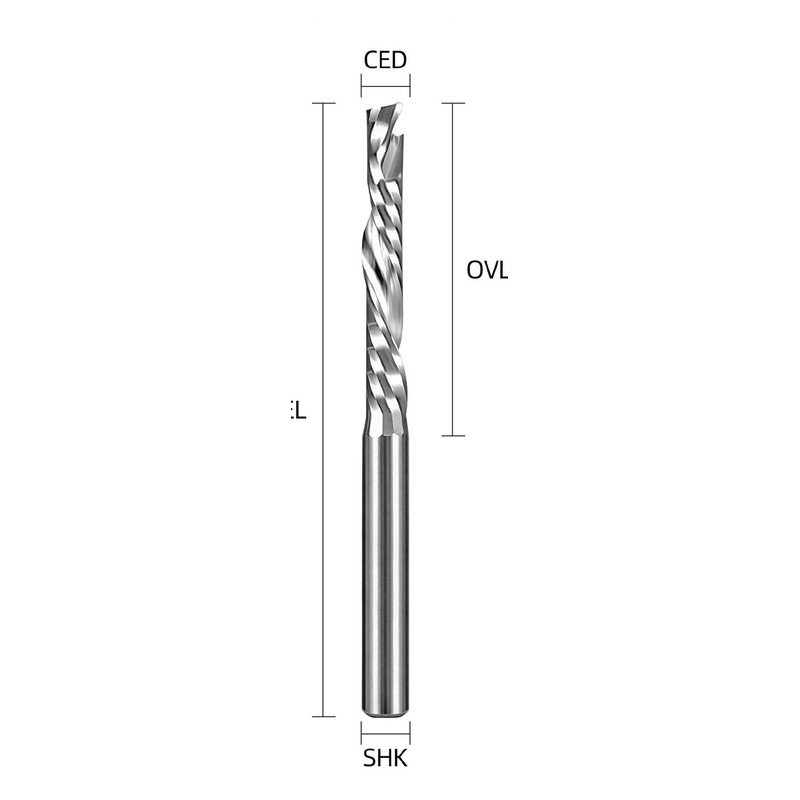
For acrylic, PVC, aluminium composite panel, plywood, MDF, particle board and glued timber. Run on CNC nesting routers, advertising CNC engraving machines and CNC machining centres.
| Shank (mm) | Cutting Ø (mm) | Cutting length (mm) | Overall length (mm) |
|---|---|---|---|
| 3.175 | 2 – 3.175 | 12 – 32 | 38 – 55 |
| 4 | 4 | 12 – 32 | 45 – 55 |
| 5 | 5 | 22 – 28 | 45 – 50 |
| 6 | 6 | 17 – 32 | 50 – 60 |
| 8 | 8 | 25 – 42 | 60 – 80 |
Two-flute compression end mill
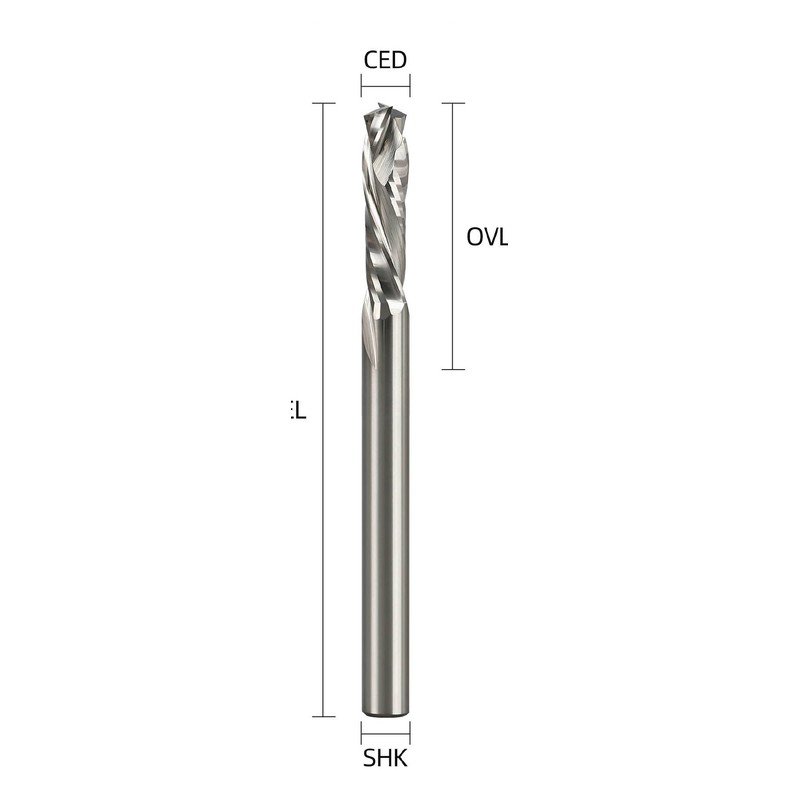
For MDF, particle board, plywood, melamine-faced board, walnut, softwood, thick acrylic and PVC board. Run on CNC nesting routers, CNC engraving machines, CNC routers and compact CNC machining centres.
| Shank (mm) | Cutting Ø (mm) | Cutting length (mm) | Overall length (mm) |
|---|---|---|---|
| 3.175 | 3.175 | 12 – 22 | 38 – 50 |
| 4 | 4 | 17 – 32 | 45 – 65 |
| 5 | 5 | 22 – 25 | 50 |
| 6 | 6 | 17 – 42 | 50 – 75 |
| 8 | 8 | 22 – 52 | 60 – 80 |
| 10 | 10 | 45 | 80 |
| 12 | 12 | 42 – 45 | 75 – 100 |
Both families are available uncoated or with a multi-colour coating, which is normally chosen for continuous production where the extra edge life is worth the cost.
Frequently asked questions
What is a compression router bit used for?
Cutting two-sided laminated panels — melamine, veneered plywood, laminate and other double-faced sheet goods — where both the top and bottom faces have to stay chip-free. It is used on cabinet and furniture panels and on any through cut where both edges will be visible.
How does a compression bit leave both edges clean?
The tool has an up-cut section at the tip and a down-cut section above it. As it cuts through the panel, the up-cut tip lifts the bottom fibres upward and the down-cut section presses the top fibres downward, so the fibres on both faces are pushed toward the centre of the panel instead of being lifted or torn outward.
Can I use a compression bit for a shallow or blind cut?
No. The two sections only work together when the cut engages both of them, so the first pass has to be deeper than the up-cut section at the tip. On a shallow or blind cut only one section cuts and the bit behaves like a plain up-cut or down-cut tool. For shallow work, a dedicated up-cut or down-cut bit is the better choice.
Is a compression bit worth it for single-faced material?
Only if both faces must stay clean on a through cut. For a single visible face a down-cut bit is usually enough, and where the faces are not critical an up-cut bit clears chips better and costs less.
Should I use a single-flute or a two-flute compression bit?
Single-flute gives more chip room and is useful where chip evacuation is tight; two-flute gives a stronger cutting action and a better finish at higher feed. The choice depends on your material, panel thickness and machine. Tell us the application and we will recommend a geometry.
Related guides and tools
Need a matched tool recommendation?
Tell us the panel material, thickness and machine. YINGBA will review your requirement and prepare a B2B quotation.